


The MP for Tonbridge vows to restore public trust in the Conservative Party following recent Westminster controversies.

Tom Tugendhat has vowed to bring integrity and honesty back to politics as he officially kicks off his campaign to become the next leader of the Conservative Party. In a speech in central London, the former minister will make a strong case for his leadership, insisting that only under his guidance can the Tories regain the public’s trust after the “recent games” at Westminster that have tarnished the party’s reputation.

Tugendhat, currently serving as the shadow security minister, is expected to outline his priorities, which include a significant boost in defence spending, aiming for 3% of the UK’s GDP, and reinforcing the unity of the United Kingdom. “We need a government that serves, leads, and acts,” he will say. “That’s why I’m standing here today, because I believe this country can change, and it must change.”

The Tonbridge MP will also emphasise the importance of public service in his leadership pitch, stating: “As leader, my promise is to return to a government that is honest and responsible. We must rebuild trust and confidence in the future, because I know this country holds the best potential for success.”

In his bid, Tugendhat will also address the need for a reset in the Conservative Party’s image with the public. He will condemn the “recent games” in politics and stress that the people deserve a government that prioritises action over political gamesmanship. “That’s why I’m here today – to lead the change this country urgently needs,” he will declare.

The security-focused politician will also reaffirm his commitment to confronting global threats, particularly from hostile states such as Russia and Iran. “We are facing an increasingly dangerous world, and it’s imperative we invest in our security and ensure our future doesn’t rely on the decisions of others,” Tugendhat will say.

In addition to his security policies, Tugendhat will lay out his vision for economic renewal, which will focus on investing in skills and infrastructure across the UK. He will draw inspiration from the work of Lord Ben Houchen, the Tory mayor of Tees Valley, who has implemented successful local reforms.

With his leadership bid already gaining momentum through several televised speeches and visits to various UK regions, Tugendhat now enters a crowded field, with former ministers like Robert Jenrick, Mel Stride, James Cleverly, Dame Priti Patel, and Kemi Badenoch also vying for the top position. Badenoch is widely seen as a frontrunner in the race.

In an effort to avoid the divisions seen in the 2022 leadership contest, candidates have been urged not to engage in personal attacks during this campaign. However, Mr. Jenrick has come under fire from some of his rivals over his stance on leaving the European Convention on Human Rights, which he has argued would be a long and ultimately unsuccessful endeavour.


The dismissal comes after an F-16 pilot tragically died during a mission to protect Ukraine from a Russian strike.

Ukrainian President Volodymyr Zelensky has dismissed the commander of Ukraine’s air force just days after an F-16 pilot lost his life while defending against a large-scale Russian attack. This marks a significant shift in Ukraine’s military leadership following the tragic incident involving Lieutenant Colonel Oleksiy Mes, known by his callsign “Moonfish,” who was killed during a battle in the skies.

The crash occurred on Monday amid a Russian offensive that saw a barrage of drones and missiles aimed at Ukraine’s critical energy infrastructure. Mes, a prominent figure in Ukraine’s air force, was among the first pilots to operate the US-made F-16 fighter jets, a crucial component of Ukraine’s air defence. In the aftermath of the crash, there were claims from Ukrainian MP Mariana Bezuhla that the pilot may have been downed by friendly fire from a US Patriot missile, a statement which sparked a furious response from Lieutenant General Mykola Oleshchuk, the now-removed air force commander. Oleshchuk refuted the accusations, which led to tensions between the military leadership and government officials.

While the air force did not outright deny the claims, it did note that American experts were involved in investigating the crash. However, the controversy was short-lived, as President Zelensky announced Oleshchuk’s dismissal in a nightly address, stressing the need for leadership that could better support Ukraine’s military efforts. Zelensky expressed his gratitude to all those in Ukraine’s armed forces, including pilots, engineers, and air defence units, highlighting the importance of strengthening both personnel and command structures.

Oleshchuk had served as the head of Ukraine’s air force since August 2021, months before Russia’s full-scale invasion of Ukraine. Following his removal, Lieutenant General Anatolii Kryvonozhko, who had previously overseen air operations in central Ukraine, has been appointed as interim commander of the air force.

The tragic death of Oleksiy Mes serves as a reminder of the intense challenges faced by Ukrainian pilots. He had long advocated for Ukraine to be supplied with F-16s and was one of the first to operate the aircraft in combat. On the Day of Remembrance for Fallen Heroes, hundreds of soldiers and civilians paid their respects to him, remembering his heroism in saving countless lives by intercepting Russian missiles, even at the cost of his own.

The United States and NATO allies have pledged to provide Ukraine with approximately 65 F-16 jets, but due to the need for extensive training, the first batch of planes only arrived in Ukraine earlier this month. Mes’s death underscores the perilous nature of Ukraine’s aerial defences in its ongoing struggle against Russian aggression.

Analysis reveals that many individuals are receiving far below the full state pension amount, with some getting as little as £10 per week.

An alarming number of people receiving the new state pension are getting far less than the full weekly amount, with an analysis by Royal London revealing that around 150,000 pensioners are receiving under £100 a week. This data, compiled from the Department for Work and Pensions (DWP) figures from spring 2023, highlights that many individuals are not receiving the full state pension despite being eligible.

Out of the 3.4 million people receiving the new state pension, only 1.7 million individuals are getting the full £221.20 per week, which is the state pension amount for 2024/25. The full amount increased from £203.85 the previous year. Many pensioners have fewer than the required 35 years of National Insurance contributions (NICs) to qualify for the full pension. Those with fewer years of NICs will receive a reduced amount, based on how many qualifying years they have.

A concerning figure from the analysis shows that 149,317 pensioners receiving the new state pension, particularly those who reached the state pension age after April 2016, are receiving less than £100 a week. Additionally, there are 17,546 pensioners whose weekly pension is under £20, with 5,677 of them receiving less than £10 a week.

The new state pension system, introduced in 2016, aims to provide a clearer and more sustainable foundation for retirement savings, allowing people to build on private pensions. However, Royal London’s study reveals a significant issue, as many individuals are left without sufficient income in their retirement.

A prior survey conducted by Royal London revealed that approximately one in five people aged 66 and above were solely dependent on the state pension. On a positive note, low-income pensioners may be eligible for pension credit, which could provide up to an additional £3,900 annually. The DWP has recently launched a campaign to raise awareness about this support, urging those who qualify to claim.

In addition to pension credit, individuals with gaps in their National Insurance records can make additional contributions to increase their state pension entitlement. However, many pensioners may not realise they have gaps in their records until it’s too late to correct them. These gaps could have arisen due to periods of low earnings, unemployment without claiming benefits, or working abroad.

The DWP encourages those on the lowest incomes to apply for pension credit, a benefit that can help fill the financial gap for pensioners struggling with low incomes. Furthermore, individuals with gaps in their National Insurance records due to certain life circumstances, such as caring for a child under 12 or caring for someone receiving specific benefits, may qualify for free National Insurance credits to fill these gaps.

It is crucial for pensioners to regularly check their National Insurance contribution records and ensure they are receiving the correct amount of state pension. Individuals can request a state pension forecast to assess any gaps in their contributions and make the necessary arrangements to address them.

The deadline for paying voluntary National Insurance contributions to fill gaps for the years between April 2006 and April 2018 is fast approaching, with the final date set for 5 April 2025. After this, only the last six years’ worth of contributions can be retroactively made.

Helen Morrissey, head of retirement analysis at Hargreaves Lansdown, advises pensioners to check their records and plan for any gaps to avoid missing out on the full pension entitlement.

The largest dam removal project in US history will restore free passage for salmon along 400 miles of the Klamath River, revitalising vital habitats for the species.

For the first time in over 100 years, salmon will soon have unrestricted access to the Klamath River and its tributaries, marking a significant step in the largest dam removal project in US history. The project, taking place along the California-Oregon border, will restore the natural flow of the river, allowing salmon to return to crucial habitats just in time for the fall Chinook spawning season.

In the coming days, excavation teams will breach rock dams that have been diverting water upstream of two already removed dams—Iron Gate and Copco No. 1. This will allow the river to flow freely through its historic channel. The removal effort follows decades of advocacy from Native American tribes, including the Karuk Tribe, who have long fought for the restoration of the river and its salmon population.

Leaf Hillman, ceremonial leader of the Karuk Tribe, called the restoration “a good omen for our future,” noting the deep cultural and spiritual significance of salmon to the tribe. The demolition work is part of a broader initiative across the United States to restore river ecosystems by removing aging dams that obstruct natural habitats for fish and other wildlife.

The Klamath River, once the third-largest salmon-producing river on the West Coast, has faced a steep decline in fish populations due to the construction of power-generating dams by PacifiCorp between 1918 and 1962. These dams halted the river’s natural flow and disrupted the salmon lifecycle, leading to dramatic population declines. In 2002, a bacterial outbreak linked to low water levels and high temperatures wiped out over 34,000 Chinook salmon, prompting a new wave of advocacy and, ultimately, the approval for dam removal in 2022.

The project has already seen some successes, including the removal of Copco No. 2 dam and draining of the reservoirs behind the remaining structures. The total cost of the dam removals is expected to reach $500 million, funded by both taxpayers and PacifiCorp ratepayers. Despite the relatively small energy output of the dams—less than 2% of PacifiCorp’s total capacity—hydroelectric power generated by dams has long been considered a clean, renewable energy source. However, increasing concerns over the environmental impact on river ecosystems have led to the removal of several major dams in the West.

The full restoration of the Klamath River will take time, and experts remain cautious about how quickly salmon will return to their historical habitats. While some salmon have already been spotted at the river’s mouth, it’s uncertain how long it will take for them to reach their former spawning grounds.

Mark Bransom, CEO of the Klamath River Renewal Corporation, which is overseeing the project, noted that similar efforts, such as the removal of the Elwha River dams, took years to show tangible results. “You can’t undo 100 years of damage overnight,” Bransom acknowledged, though he remains hopeful for the long-term recovery of the river and its fish populations.

The Dutch defender joins from Liverpool, turning down Bayer Leverkusen in favour of a long-term move to the Bees.

Brentford have officially announced the acquisition of Sepp van den Berg from Liverpool for a transfer fee that could rise to £25million. The deal is structured with an initial £20million upfront payment, alongside a potential £5million in performance-related add-ons. Van den Berg, who has committed to a five-year contract with the Bees, becomes their fifth signing of the summer window.

The highly-rated Dutch centre-back rejected interest from Bundesliga giants Bayer Leverkusen to make the move to the Premier League. After completing a medical on Wednesday, Van den Berg joins a growing list of recent arrivals at Brentford, which includes fellow former Liverpool player Fabio Carvalho, Igor Thiago, Benjamin Fredrick, and Julian Eyestone.

Van den Berg initially signed for Liverpool in 2019 for £4.4million, although his opportunities with the Reds were limited, making just four senior appearances over five seasons.

Brentford head coach Thomas Frank expressed his delight at securing the signing, stating: “I’m very pleased that we’ve been able to bring Sepp in. This is a fantastic addition to the team. Sepp is a solid centre-back with high potential, and I’m confident he can continue to improve with us.”

Frank went on to highlight the 21-year-old’s attributes, praising his speed, game intelligence, and composure on the ball, both in defensive situations and during build-up play. “He embodies the style and values we want in our team. Sepp is also a great character, and I believe he will integrate well with the squad and help us progress as a club,” Frank added.

Former president delivers a muddled address in Wisconsin, warning of the threat of World War Three while criticising the left’s stance on law enforcement.

On Tuesday, 20 August, Donald Trump delivered a disjointed and low-energy speech at the Livingston County Sheriff’s Office in Howell, Wisconsin, where he was expected to discuss the topic of “law and order.” However, his remarks veered off track, touching on a range of issues from global conflicts to political ideologies.

The former president began by stating that “World War Three” was “very close,” invoking global tensions as a backdrop to his criticism of the left-wing agenda. He accused the “Marxist left” of launching a relentless attack on law enforcement, claiming that they had stripped police officers of their dignity and morale.

As his speech continued, Trump turned towards the officers standing behind him and asked them to vow never to “be woke,” a statement that sparked confusion and underscored the chaotic nature of the address. The phrase “woke” has become a popular term in American politics, often used by conservatives to criticise progressive social policies and movements.

Trump’s address, marked by rambling rhetoric and disjointed topics, left many questioning the clarity and purpose of his message. The speech, which was intended to reinforce his tough-on-crime stance, instead highlighted his tendency to make sweeping, controversial statements without clear focus or direction.

Susan Lorincz, 60, is found guilty after fatally shooting Ajike Owens in a dispute over her children playing outside.

A Florida woman has been convicted of manslaughter following the fatal shooting of her Black neighbour, Ajike “AJ” Owens, in a dispute over children playing outside. On Friday, an all-white jury in Central Florida found Susan L Lorincz, 60, guilty of manslaughter after deliberating for two hours during a four-day trial.

The incident took place on 2 June 2023, when Owens’ children were playing in a field near Lorincz’s home in Ocala. Lorincz became involved in an argument with the children, during which she threw a pair of skates at them, injuring Owens’ 10-year-old son. When Owens’ 12-year-old son confronted her, Lorincz opened her door and swung an umbrella at him. The children returned home and informed their mother of the altercation.

This was not the first dispute between the women; they had a history of tension regarding the children playing outside. Lorincz had previously called the police over minor incidents involving Owens, including allegations of throwing a “no trespassing” sign at her in 2022 and repeatedly accessing her mailbox in 2023.

On the day of the shooting, Owens confronted Lorincz by knocking on her door and demanding she come outside. Instead of responding, Lorincz fired a .380-caliber handgun through the door, striking Owens in the chest while her 10-year-old son stood beside her. Owens was later rushed to hospital but succumbed to her injuries.

Lorincz claimed she acted in self-defence, expressing fear for her life in a letter to Owens’ family. She stated, “I shot out of fear… I was terrified your mom was going to kill me.” Initially, authorities delayed arresting her while they evaluated whether Florida’s “stand your ground” law, which permits the use of deadly force in some situations, applied. However, it was determined that the law did not justify the shooting, as Owens was unarmed at the time.

Lorincz was arrested on 6 June 2023 and charged with manslaughter with a firearm. She faces up to 30 years in prison, with a sentencing hearing to be scheduled. Throughout the trial, Owens’ family expressed their grief and outrage. Owens’ mother, Pamela Dias, shouted after the verdict, “She set out to cause harm. She set out to kill.”

The case has sparked national debate over Florida’s “stand your ground” laws, particularly in light of similar incidents where unarmed individuals have been shot while on private property. Civil rights attorney Ben Crump, who represented Owens’ family, condemned these laws, stating, “What does it say when a person can shoot and kill an unarmed mother in the presence of her young children and not be immediately taken into custody?”

The retailer is one of six organisations selected to test beyond visual line of sight drone operations in the UK.

Amazon has been selected to participate in a ground-breaking drone flight trial in the UK, aimed at advancing the use of drones for delivery services. The company, along with five other organisations, will take part in trials involving beyond visual line of sight (BVLOS) flights. This means drone operators will no longer be required to keep the flying devices within their direct line of sight.

As part of its initiative, Amazon plans to launch its Prime Air service in the UK by the end of the year, offering rapid deliveries of small packages within an hour of an order being placed. Amazon already operates drone deliveries in the United States, with services running in Lockeford, California, and College Station, Texas.

The Civil Aviation Authority (CAA), the UK’s aviation regulator, has also selected other projects for the BVLOS trial, including drone operations for offshore wind farm inspections, emergency medical deliveries, and air traffic control services. Additionally, the National Police Air Service, NATS (the air traffic control provider), and the Scottish islands of Orkney are involved in the trial.

Sophie O’Sullivan, CAA’s director of the Future of Flight programme, described the initiative as a major milestone for safely integrating drones into the UK’s airspace. “These trials are crucial for gathering data to shape the future of drone regulation and policy,” she stated. “Our goal is to make BVLOS operations safe and commonplace, contributing to the modernisation of airspace and the seamless integration of new technology.”

David Carbon, Amazon Prime Air’s vice president and general manager, emphasised the importance of having clear regulatory guidelines. “Having a transparent regulatory framework is vital for the growth of technologies like drone delivery,” he said. “We are grateful for the CAA’s partnership in providing clarity to support the commercial deployment of drones.”

The renowned street artwork has been moved to a safer location following previous incidents of theft.

A new installation by the elusive street artist Banksy, featuring piranhas in a police sentry box, has been relocated for its own protection. The artwork, previously displayed near the Old Bailey, is now safely housed in Guildhall Yard by the City of London Corporation. A spokesperson for the Corporation explained: “We have moved the artwork to ensure it is safely displayed and accessible to the public.” A permanent site for the piece will be determined at a later date.

This piece is part of a series of eight animal-themed artworks unveiled in London recently. Banksy has been sharing these pieces on his Instagram daily since August 5. One of his notable works shows a rhinoceros perched atop a silver Nissan Micra, complete with a traffic cone on its bonnet. The image, which creates the illusion of a rhino mounting another in the form of a broken-down car, was placed on Westmoor Street in Charlton, southeast London. The traffic cone is depicted as the rhino’s horn.

Banksy’s ongoing series also includes other animal-themed works, such as elephants, monkeys, a wolf, pelicans, and fish, which have appeared throughout London in various locations. A local worker near the latest installation expressed his surprise, saying it was the first time he had encountered one of Banksy’s pieces, adding that it was an exciting and refreshing experience.

Daniel Lloyd-Morgan, an artist who has been following the new works closely, described the rhino piece as the best in the series. He admired its creativity, especially the way the glass of the car’s sunroof appeared to have been crushed under the rhino’s weight. The installation has caught the attention of locals, with many sharing their excitement about the iconic artist’s work.

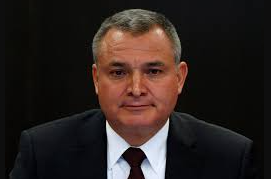
A judge dismisses Genaro García Luna’s plea for a new trial after uncovering his efforts to bribe fellow inmates to testify falsely.

A U.S. judge has rejected the request of Genaro García Luna, a former senior Mexican official, for a new trial after discovering that he attempted to bribe fellow inmates to provide false testimonies in his favour. García Luna, who previously held a high-ranking position as Mexico’s public safety head, was convicted last year of accepting bribes to protect the very drug cartels he was supposed to combat. He is currently awaiting sentencing and maintains his innocence.

The bribery attempts, uncovered by prosecutors, involved an inmate’s handwritten notes and a covertly recorded conversation between García Luna and a cellmate. His defence team dismissed these allegations, claiming the evidence was unreliable and the recordings unclear. However, U.S. District Judge Brian Cogan found the evidence compelling, stating that it clearly illustrated a scheme to obstruct justice through bribery.

García Luna’s defence lawyers expressed their discontent with the decision, highlighting that the court failed to address key issues, such as false testimony from prosecution witnesses and withheld evidence. Despite this setback, García Luna intends to appeal the ruling.

In addition to the bribery claims, defence attorneys presented a sworn statement from an inmate who stated that a prosecution witness at the Brooklyn federal jail had spoken about his intention to falsely testify against García Luna. The inmate also claimed that the witness had used a contraband cellphone to communicate with another government witness. Defence attorneys argued that these communications showed the existence of a conspiracy to frame García Luna, but prosecutors rejected these allegations, noting the mental health condition of the inmate who provided the statement. They also revealed that García Luna had offered up to $2 million to inmates in exchange for false testimonies.

The court documents revealed that García Luna’s efforts to manipulate witnesses included asking an inmate to convince another to fabricate a story about overhearing a conversation that would implicate the second government witness in a false bribery accusation. The intermediary involved in the bribery was reportedly a former cellmate of García Luna, who provided notes and recordings to support the claim.

García Luna, convicted of engaging in a continuing criminal enterprise, faces a sentence ranging from 20 years to life in prison when sentenced on October 9. The former public security secretary of Mexico served in the position from 2006 to 2012.